
What to Do When You Don’t Know Where to Start With AI
Sophie, Learning and Content Specialist at Lake House Group
You open a conversation with an AI tool, ChatGPT, Claude, whatever you are using. It asks you to describe your writing style. You try to think of a few words, but freeze, not knowing where to start. That freeze is not a sign you lack self-awareness. It is a sign you were asked the wrong kind of question. This article is a practical starting point for anyone using AI in their daily work and not getting output that sounds like them. It’s a simple process to use when you are staring at a blank chat window and do not know where to begin.
A few weeks ago, I needed to build a writing style guide: a document that would help AI produce content that actually sounds like me. Instead of starting from scratch, I opened a conversation with Claude and asked it to interview me.
It asked what kind of writing I admire. It showed me sample sentences and asked which ones felt right. It asked what makes me cringe in AI-generated content. It gave me examples to react to, and my reactions surfaced preferences I would not have been able to describe from a blank page. Within an hour, I had a working style guide built entirely from my own taste.
Why this works
Cognitive psychology has a name for this: the recognition–recall distinction. Recognition is easier than recall. That is why multiple-choice tests are usually easier than essay questions. In a multiple-choice question, the answer is in front of you. Your brain only has to identify what fits. In an essay question, you have to produce the answer without any cue.
The same thing happens when people try to guide AI.
When Claude asked me to describe my writing style from nothing, I froze. That was recall, pulling knowledge out of memory with no support. When it showed me a sentence and asked, “Does this sound like you?”, I could answer immediately. That was recognition. I was not inventing an answer. I was responding to something concrete.
That is why the interview format works. AI gives you material to react to. Your reactions become the instructions.
What surprised me
What I did not expect was how much the process taught me about my own preferences.
When Claude showed me a sentence like, “In today’s rapidly evolving AI landscape, businesses must adapt or risk being left behind,” I did not just know I disliked it. I had to explain why. Every word felt clichéd. There was no specific claim. There was no reason to keep reading.
That explanation became a rule in the style guide.
Each reaction made the next one easier. By the end of the conversation, I was not only identifying what I liked and disliked, I was understanding the principles behind those preferences.
The interview did two things at once. It produced a useful document and it made my own thinking more precise.
How to try this
Start with a task you do often: writing emails, preparing reports, or creating client communications.
Ask AI to interview you about how you approach that task. Tell it to ask one question at a time and to show you examples you can react to. If you have access to a voice input tool like Wispr Flow, try speaking your reactions instead of typing. You will get richer, less filtered answers that are closer to how you actually think and talk.
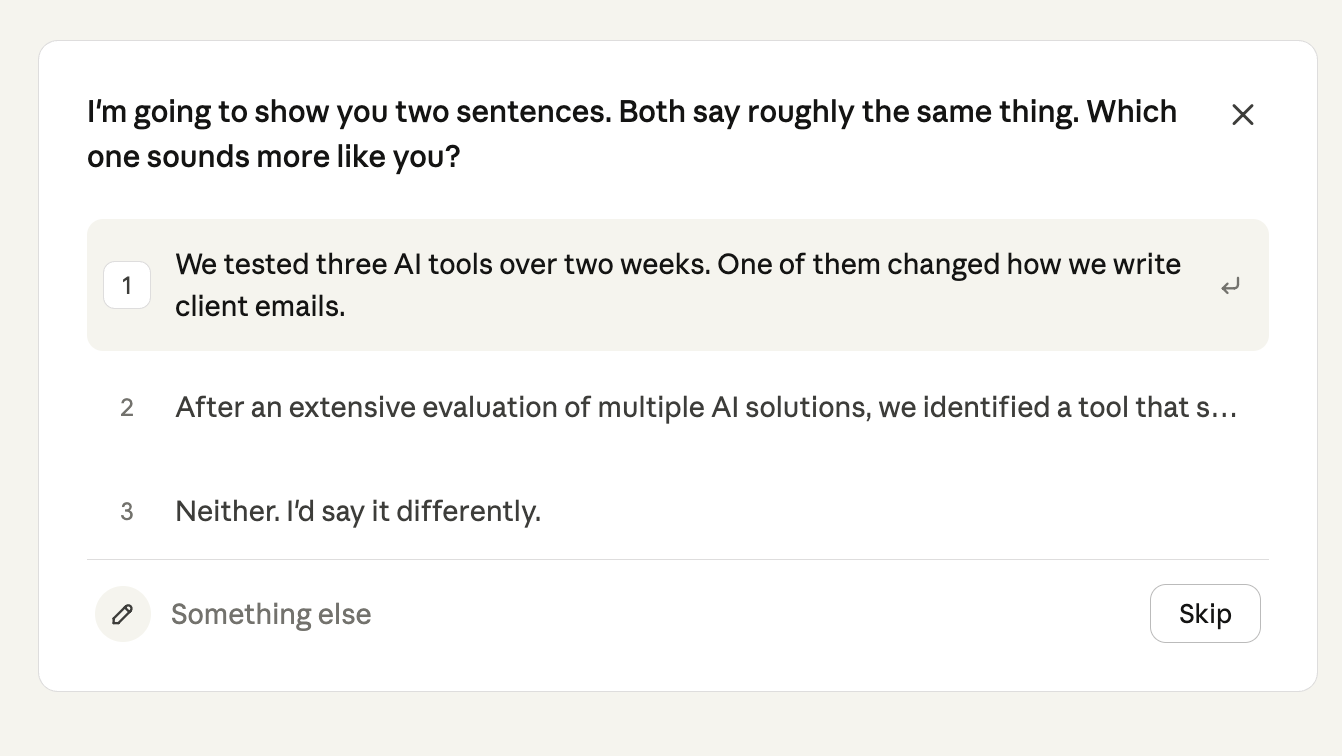
Without context, AI is guessing. The interview gives it access to your preferences, standards, and patterns.
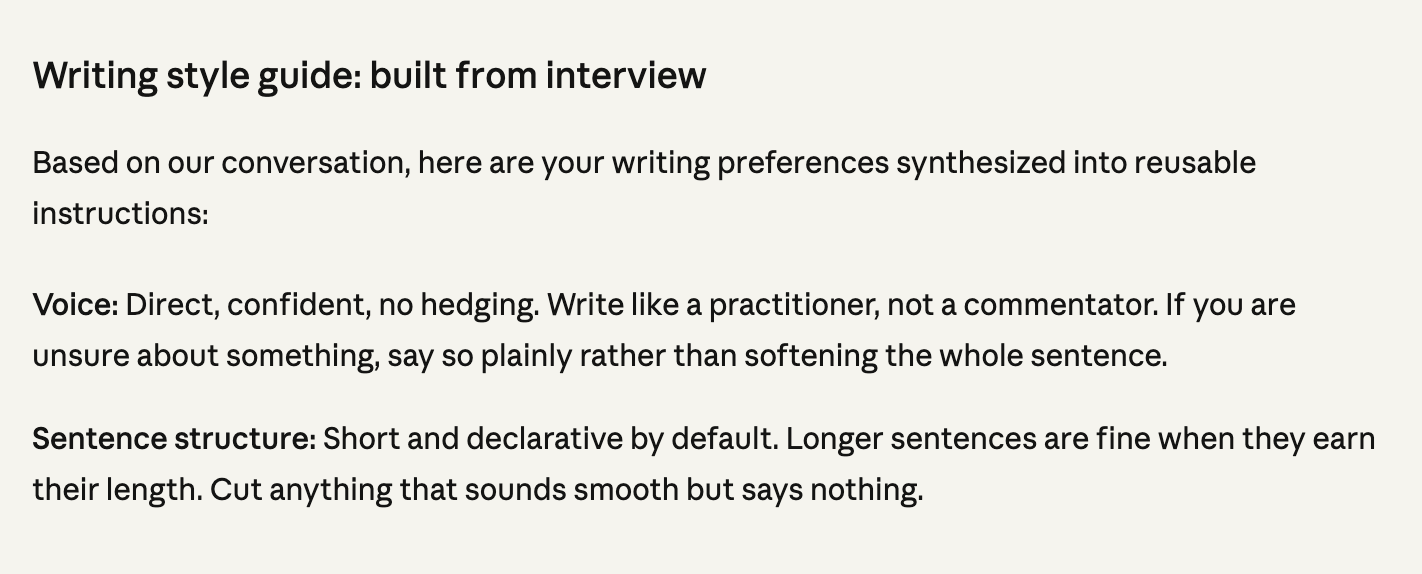
After a few exchanges, ask AI to synthesize what it learned into a reusable set of instructions. Then use those instructions in your next conversation and compare the result.
The Takeaway
The interview forced me to explain why I liked or disliked something. Those explanations became rules. Rules became a style guide. The whole process felt natural in a way that staring at a blank document and writing standards from memory never did. That is not a shortcut. You are doing the same thinking, building criteria, making judgment calls, articulating standards. You are just starting from a place your brain can actually access.